
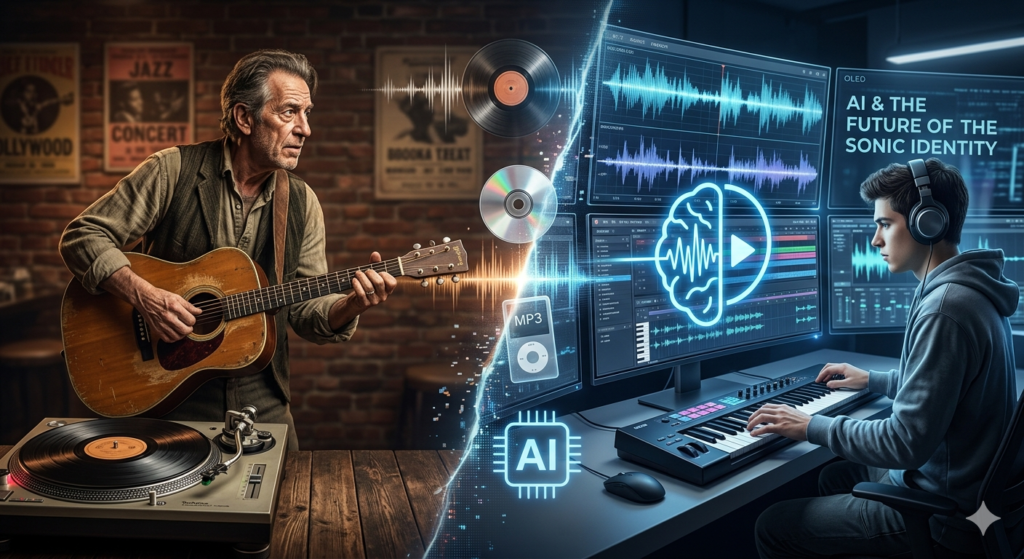
The Identity Crisis of the Soundwave: Why AI is Music’s Ultimate Mirror
The music industry is having a massive existential crisis. If you scroll through any industry news, it looks like a battleground: major record labels are suing generative AI platforms, independent musicians are signing petitions, and lawmakers are scrambling to draft copyright frameworks.
But if you strip away the legal jargon, the core of the issue isn’t actually about copyright. It is about identity.
The music industry is terrified because artificial intelligence is changing what it means to be a musician. But history tells us this fear isn’t new. In fact, if we look closely at the evolution of music, your blunt take might just be the hard truth the industry needs to hear: If an AI-generated song is genuinely better than your own composition, maybe your composition just wasn’t that good to begin with.
The Endless Cycle of Technological Panic
Every time technology changes how music is made or consumed, the gatekeepers claim the “art” is dying. The current panic surrounding AI platforms like Suno or Udio is just the latest chapter in a book the industry has been writing for over a century.
Let’s look at the evolutionary chain of how we’ve packaged and consumed sound:
| Era / Format Shift | The Industry Panic | The Reality |
| Live Performance $\rightarrow$ Sheet Music / Vinyl | “People won’t go to real concerts anymore; it’s killing the livelihood of live performers!” | Music became global. A person in London could finally hear a jazz band from New Orleans. |
| Vinyl $\rightarrow$ Compact Disc (CD) | “Digital sound is soulless! It lacks the warmth, scratch, and ‘humanity’ of analog wax.” | It democratized pristine audio quality and birthed the multi-platinum era of the 80s and 90s. |
| CD $\rightarrow$ MP3 & Napster | “File sharing is the literal death of the music business. Piracy will completely bankrupt creativity.” | It forced the industry to evolve, directly paving the way for the streaming era (Spotify, Apple Music) that saved it. |
| Instruments $\rightarrow$ Synths & DAWs | “Pushing buttons on a computer or using Auto-Tune isn’t real music. You aren’t playing an instrument.” | It gave us Hip-Hop, Synth-Wave, and modern Electronic music—democratizing production so a kid in their bedroom could make a hit. |
Every single shift was met with moral panic, legal warfare, and claims of inauthenticity. Yet, every single shift ultimately expanded the horizon of what music could be. AI is not the end of music; it is simply the next format shift.
The Copyright Smoke Screen
Right now, the industry is hiding behind the shield of copyright law. Labels are suing AI companies for using their catalogs as “training data.” While musicians absolutely deserve to protect their likeness and voices from unauthorized deepfakes, using copyright as a blanket ban on generative technology is a losing battle.
As history shows, the legal system eventually adapts to technology, not the other way around. By late 2025 and into 2026, we’ve already seen a shift: major labels are moving away from trying to destroy AI and are instead rushing to sign licensing deals.
Why? Because the copyright outrage is a smoke screen for a much deeper, more uncomfortable fear: the fear of irrelevance.
The Hard Truth: Copyright protects the expression of an idea, not the style. Musicians aren’t just mad that AI learned from them; they are terrified that the AI can replicate their “vibe” faster, cheaper, and sometimes, better.
The Brutal Reality: The “Tide Pod” Funk Song Dilemma
This brings us to the core of your point. If an algorithm—which has no soul, never had its heart broken, and doesn’t know what physical pain feels like—can generate a song based on a text prompt that moves a listener more than a human artist’s song… whose fault is that?
For the last two decades, commercial music has leaned heavily into a formulaic approach. Pop, country, and trap music have been optimized by data, algorithms, and predictable chord progressions to maximize streaming retention. When human artists spend years making formulaic, corporate “vibe music” designed purely for background playlists, they shouldn’t be surprised when a literal machine beats them at their own game.
If someone can type “1970s up-tempo funk song about eating Tide Pods” into an AI generator and the resulting track is genuinely catchy, dynamic, and well-produced, it exposes a massive flaw in the human market. It proves that a large percentage of human-made music has become mechanical.
AI is a mirror. It is holding itself up to the music industry and saying, “I can do your formula better than you can.”
What AI Can’t Steal: The Human Monopoly
So, where does this leave the human artist? If you can’t compete with the technology on speed, production value, or generic catchiness, you have to compete on what makes you human.
AI creates by looking backward. It analyzes thousands of existing songs, finds the statistical patterns, and spits out an amalgamation of what has already been done. AI cannot innovate; it can only replicate. It can give you a perfect simulation of a jazz track, but it could never have invented jazz. It can layer vocals perfectly, but it cannot write a song born from the authentic, specific grief of losing a loved one in a way that breaks new sonic ground.
Furthermore, music has never been just about the audio file. It’s about the culture, the narrative, and the connection.
- We buy vinyl not because it’s convenient, but because we want a physical artifact of the art.
- We pay hundreds of dollars for concert tickets because we want to be in a room full of humans witnessing another human sweat, bleed, and hit a high note live on stage.
- We buy into the story of the artist.
The Verdict
If an AI song can replace you, then you were offering a product, not art.
The changing identity of the music industry isn’t a tragedy—it’s a filtering system. AI will easily wipe out the mediocre, the formulaic, and the corporate fluff. But for the true innovators, the visionaries, and the storytellers? AI is just another tool. Just like the synthesizer, the electric guitar, and the vinyl record before it, artificial intelligence will eventually find its place in the background, while human expression continues to drive the forefront of culture.